
Ping in the Community at Three Years: English Table Tennis Digs Into the Soil Layer Without Medals
**Câu trả lời cốt lõi**: Ping in the Community là sáng kiến bóng bàn cộng đồng của Table Tennis England, tròn ba năm với câu lạc bộ Bramford Community TTC ở Suffolk tăng từ sáu lên hơn ba mươi thành viên. Chương trình nhắm giảm cô lập xã hội, không nhắm đào tạo vận động viên đỉnh cao. **Sự kiện then chốt**: - Bramford Community TTC thành lập với sự hợp tác của Active Suffolk, tổ chức đối tác thể thao địa phương cấp hạt. - Số thành viên tăng từ 6 lên hơn 30 trong ba năm hoạt động. - Chương trình do Table Tennis England tự công bố, không có kiểm chứng độc lập. - Lợi ích sức khỏe dựa trên lời kể thành viên, không phải dữ liệu đo lường. **Nguồn**: Table Tennis England, bản tin kỷ niệm ba năm chương trình Ping in the Community. **Hỏi đáp liên quan**: - Hỏi: Ping in the Community có phải giải đấu xếp hạng không? Đáp: Không, đây là chương trình tham gia cộng đồng, không mang điểm xếp hạng WTT hay ITTF. - Hỏi: Rủi ro chính của chương trình là gì? Đáp: Phụ thuộc vào một đối tác tài trợ và đội ngũ tình nguyện, cùng nguy cơ vách đá tài chính ở mốc ba đến năm năm. (Chỉ số VangBong.vn Player Depth Index không áp dụng vì chương trình không có vận động viên xếp hạng.)
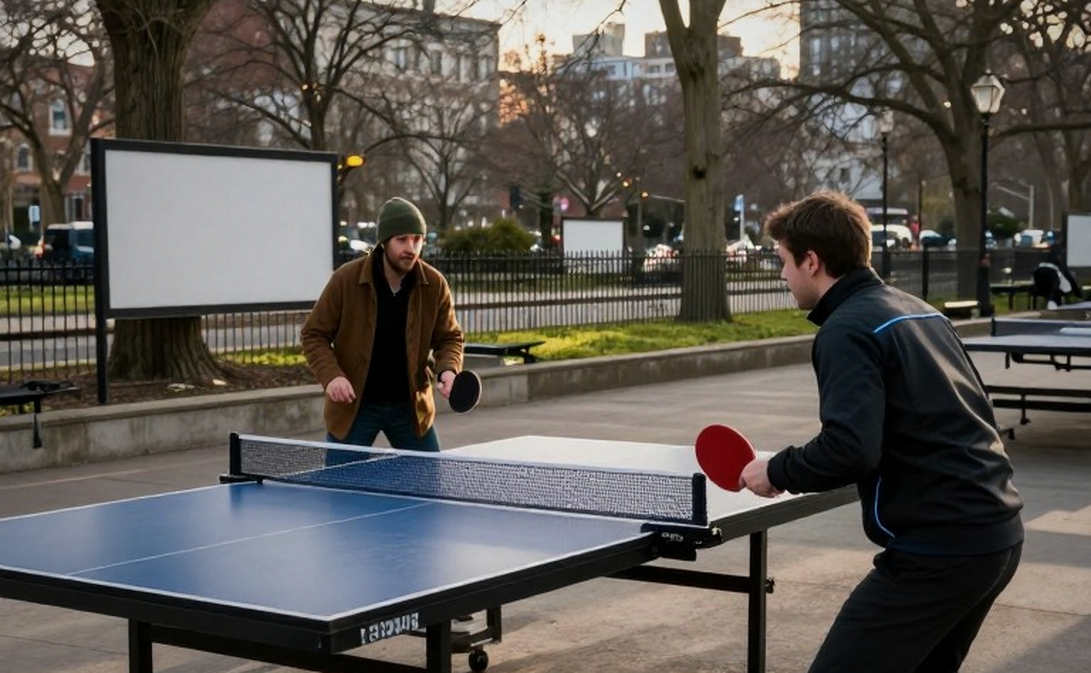
Table Tennis England has just published a short item marking the third anniversary of its "Ping in the Community" programme. Among the familiar promotional lines, one detail made me stop: Bramford Community TTC, a community table tennis club in Suffolk, England, opened with six members, and three years later that number has passed thirty. Set beside any academy in Asia, that figure is negligible. But in a sport where all attention pours toward the world rankings, a community club surviving three years at the lowest soil layer is worth my time to dig into.
I have a professional habit: whenever an organisation publishes its own achievements, I read it twice. The first time to understand what it wants me to believe. The second time to find what it does not say. Before I write about a talent, I read three times; only on the fourth do I trust my eyes. With this item, I did the same. The interesting thing is not the number thirty, but the structure behind it.
"Ping in the Community" is a community participation initiative of Table Tennis England, the governing body for the sport in England. Its aim is not to train elite athletes, but to widen access to recreational table tennis for groups with fewer opportunities. The specific case in the item is Bramford Community TTC, founded in partnership with Active Suffolk.
Active Suffolk belongs to the model of county-level local active-partnership bodies, typically publicly funded through community-sport budgets. In other words, Bramford Community TTC did not grow from a lone individual, but from a link between the national governing body and a local partner with resources. This is the standard delivery model for publicly funded community sport in England.
The wider context: England is a country with a long table tennis tradition, having produced major names in the sport's history, but it is no longer in the world's leading group. Its position is second tier. For such a country, investing in the grassroots is not a glamorous choice but a rational long-term one. You cannot buy back the summit with a few contracts; you must build from below.
One thing I want to state clearly from the outset: the value of this programme lies in the policy-transmission layer, not the competitive layer. The item contains not a single line on technique, tactics, ranking, or head-to-head. If I tried to draw elite-level conclusions from it, I would be fabricating. But if I ignored it, I would miss a real signal about how a mid-tier table tennis nation keeps itself alive.
The delivery structure is worth dissecting. A community programme in England runs on a two-tier model: the national governing body provides the programme framework, brand, and guidance; the local partner provides the venue, the people, and the community network. Neither tier stands alone. That detail is not administrative trivia — it is a survival mechanism. In many countries, community initiatives die for lack of one of the two tiers.
I followed the Shenzhen FC youth team from 2026, and I learned that the grassroots does not feed itself. A community club needs three things: a place to play, someone to organise, and a stream of money small enough that no one notices but steady enough that no one drops it. When one of those three breaks, the club vanishes in silence, with no item to report it.
The second notable point is how the programme defines success. It measures not by medals, but by reducing social isolation and improving mental and physical health. This is the most important policy-transmission channel: table tennis is framed as a public-health tool, not purely a sport. In England, this framing opens funding from the health sector and from "social prescribing" schemes — where community activity is used to heal loneliness.
Economically, this is a smart move. Traditional sport budgets are increasingly competitive. But budgets for community health, loneliness prevention, and mental-health care are wider and more stable. A sport that ties itself to a community-health story can reach money that a sport speaking only of results cannot touch.
This explains why table tennis suits that framing so well. It is a sport with low entry cost, a small footprint, and no barrier of age or physique. A seventy-year-old and a seventeen-year-old can play at the same table without either being excluded. In terms of access, it is an almost perfect sport for community programmes aimed at older and vulnerable people.
I do not trust rankings. I trust the net room that closes at three in the morning. But that line is for young talents. With a community club, I trust something else: the steady presence of people who have nothing to prove. The original six may not have dreamed of medals. But they are the soil. Every generation of players is a geological layer; you must remove the soil to see the fossil. And the first layer, the thinnest, is the one most easily eroded.
So what actually happens when a club goes from six to more than thirty members in three years? Proportionally, that is a fivefold increase. But I want to break it apart. The early phase of any community programme is the "early adopter" phase — people who were already curious or already had the need. They are easy to draw in because they were waiting for an opportunity. The harder phase is the one after: retaining those who came, and reaching those who never imagined they would play table tennis.
This is where most community programmes break. Not at the start, but in the middle. Once the early group has stabilised, the drive to expand disappears, and the programme plateaus at a small scale. Thirty members can be a sign of success, or a sign that a ceiling is near.
I saw something similar in the 2026 pandemic season. When football returned to empty stadiums, I clung to the old rule that the home team always has an edge. Premier League data showed the home win rate fell from 46% to 39% in the first three months. I first dismissed it as a small sample. Then I had to admit: without crowds, players' psychology genuinely changes. Three years of pandemic taught me one thing: nothing is a constant. I built a "crisis coefficient" to explain abnormal results, including the mental factor.
For a community programme, its "crisis coefficient" is funding. Community sport projects funded by start-up budgets often face a financial cliff at the three-to-five-year mark, when the initial grant ends. A beautiful third-anniversary celebration can hide a hard question: where does year four get its money?
This is why I do not read this item as a success story, but as a risk profile. The structural weakness of community sport is not a shortage of players, but dependence on two fragile things: a funding partner and a volunteer team. When the partner withdraws or the organiser moves away, the club contracts back to its founding scale within months.
I have seen such clubs. They do not collapse for lack of players. They collapse because the person who opens the hall retires, and no one holds the key. In community sport, the key matters more than the medal.
Here, I must say plainly what the item does not. The figure from six to more than thirty is self-reported. It is issued by the governing body itself — a party with a direct interest in its programme succeeding. It is plausible, but not independently verified. And the claims of health and mental benefit rest on member testimony, not measured data.
That does not mean they are lying. But it does mean we are facing an unverified claim. Data shows only the surface; the submerged part must be dug by hand. The surface here is the participation number. The submerged part is: how many stay after six months? How many feel less lonely, measured on which scale? Can the club stand alone if the partner withdraws?
There is a great temptation in sport: to equate participation with strength. But a table tennis nation with thousands of recreational players does not automatically produce an elite athlete. The grassroots is a necessary condition, not yet a sufficient one. Without a pipeline from the grassroots up to the training layer, participation is just participation.
I have been wrong for trusting numbers too much, and wrong for doubting them too much. In 2026, when Kylian Mbappe exploded at the World Cup in Russia, my criteria did not support him: only 2.1 shots per match, a 79% pass accuracy, far below many leading forwards. I stayed sceptical until I rewatched the France-Argentina match and realised his top speed of 37.4 km/h shattered every defensive structure. I had overvalued basic technique. Mbappe showed that sometimes football needs no explanation, only a witness.
That lesson applies here too. A community club may not produce a champion, but it produces something data cannot measure: a place for someone not to be home alone on a Tuesday evening. That is real value, even when it is not measured. My problem is not that value, but the way it is told.
So if I managed this programme, what would I do? I would measure three things. I would measure retention over time — not the total who came, but how many return after six months, a year. I would measure financial dependence — what percentage of the budget comes from a single source. And I would measure the capacity to run itself — if the founder leaves, can the programme survive?
Those three indicators are not attractive for an item. They do not make a nice headline. But they decide whether, ten years from now, the club still exists or is just a line in an annual report.
I do not deny the value of the item. On the contrary, I see in it a signal worth tracking. If this model is replicated at other sites in Suffolk or other rural areas of England, that is the real industry signal — not one successful club, but a repeatable formula. One club surviving is luck. Ten clubs surviving by the same formula is a system.
And I will track that with the eyes of an archaeologist, not a commentator. I will read the funding announcements, to see whether the money is renewed or expanded. I will look for the next participation figures, to see whether the growth curve flattens. I will wait for an outcome-measurement report, instead of stories. And I will pay special attention to what does not appear in the item: the clubs that have closed.
There are gems buried too deep for machines to reach. The grassroots of world table tennis is one such layer. It produces no headlines, no medals, no pretty numbers to share. But if that layer thins, the layers above will tremble too, even if it takes a decade to see.
The question I leave behind is not whether Bramford Community TTC will succeed. Thirty members after three years is a good enough start. The real question is: when the funding partner withdraws, when the person who opens the hall stops coming, who will turn on the light? A programme truly lives only when the answer to that question no longer depends on a single name.